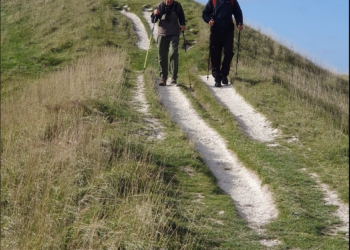
A former professional American football player from Edington is helping researchers investigate why strokes are becoming more common among younger adults after suffering one himself aged 51.
Rob Hart, who played for several NFL teams including the Miami Dolphins, Tampa Bay Buccaneers and New Orleans Saints between 2002 and 2004, is taking part in a national study supported by the Royal United Hospital (RUH) in Bath.
Rob, who became known to American football fans for kicking the ball barefoot, had been experiencing heart palpitations earlier this year and was waiting for an electrocardiogram (ECG) appointment when he suffered a stroke.
He said, “I started feeling really dizzy and my eyesight started going too. Then my hand went completely numb.
“Fortunately my wife was with me at the time and she thought it could be a stroke. She called NHS 111, who organised an ambulance straight away.
“It was a very scary time, not just for me but for my wife and children too, we just didn’t know what was happening.”
At the RUH, doctors found that Rob had suffered a stroke on the right side of his brain. They told him that a blood clot linked to his heart palpitations had travelled to his brain.
“I’ve lost about 15% of my sight in both eyes, otherwise I’ve been very lucky that there’s no other significant damage to my health,” he said.
“I’ve made some changes to my lifestyle since and the doctors are hopeful that it won’t happen again.”
Despite his experience, Rob has agreed to take part in the National Young Stroke Study, which aims to improve understanding of why strokes occur in people under 55.
The number of new stroke cases among under-55s has doubled in the UK and other high-income countries over the past decade, but researchers say the reasons for the increase remain unclear.
The study, run by the University of Oxford with hospital research teams across the country, is investigating traditional risk factors such as high blood pressure, diabetes, high cholesterol, smoking and obesity, alongside possible emerging factors including stress, long working hours and mental health conditions.
Participants take part in an interview with the research team to answer questions about their medical history, lifestyle and family history.
Rob said he was keen to help if his experience could benefit others.
“I was more than happy to take part. It was really straightforward and if it can in some way help raise awareness of potential new risk factors for strokes and how they can be prevented, then that can only be a good thing,” he said.
“I would encourage people to consider taking part in research studies like this – you really could make a vital difference to others in years to come.”
Since retiring from professional football, he has continued to keep active, running a marathon and completing a 100km charity run this year.


Send us your news!
Help us keep your community connected and informed.
Do you have an interesting story you would like to share? Have you seen something you feel needs more attention? Get in touch with a reporter today!
✉️ Click here to get in touch with a reporterSupport White Horse News
Help us keep your community connected and informed.
Local news is under pressure more than ever. Choose a monthly subscription or a one-off donation to support independent reporting in White Horse News.