Can you believe it’s ten years since the cement works chimney came down? Were you part of the gridlock that blocked Newtown early on that September morning? Or did you walk smugly past the cars to the top of the hills to watch the demolition?
Like it or loathe it; it cannot be denied that the works was an important employer in the town for nearly 50 years. When the last cloth mill closed in 1968 it was probably vital for Westbury’s economy.

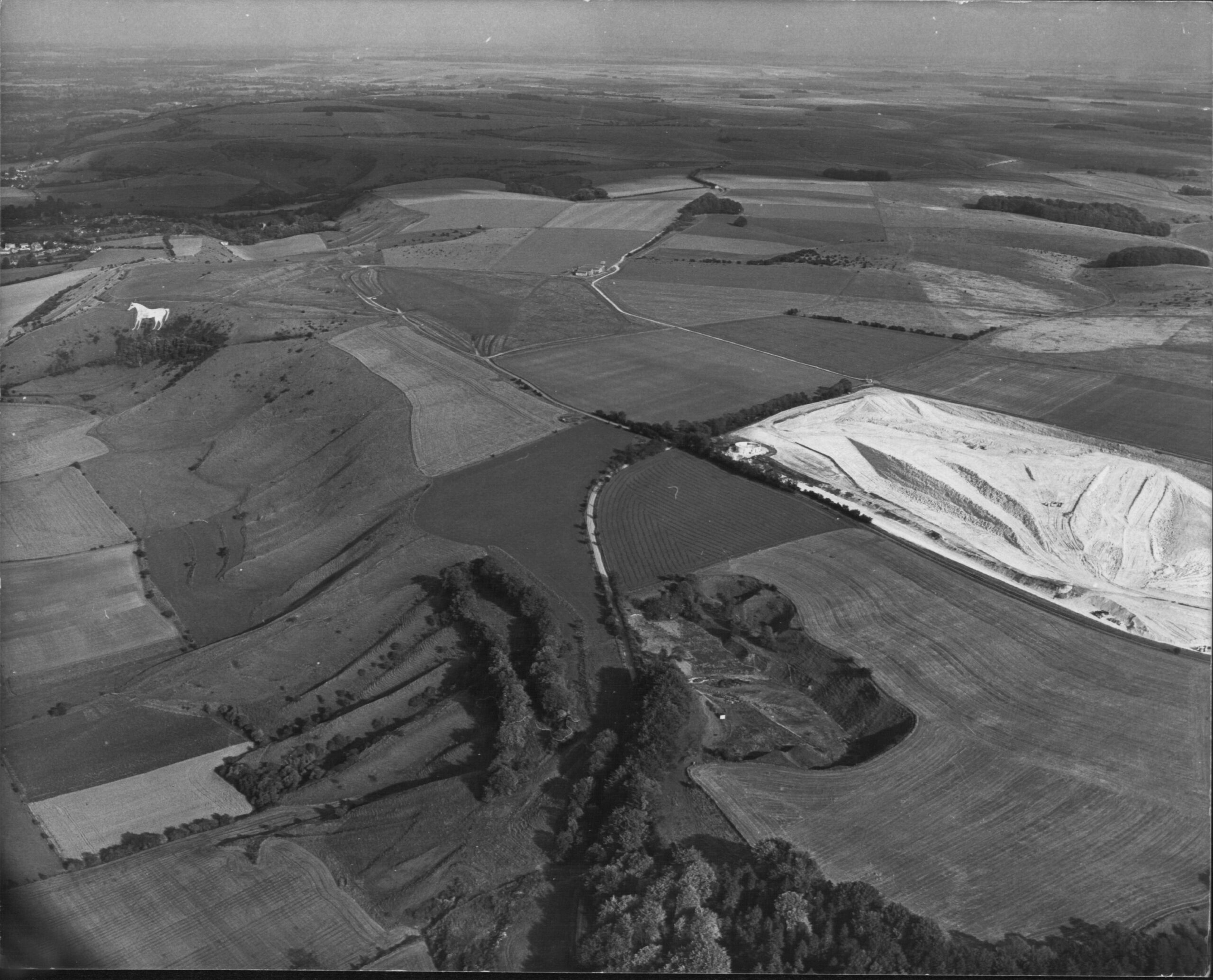

But its story really begins at the end of the Second World War. Peacetime brought the need to build new housing and demand for cement was also fuelled by the development of the motorway network. With a local supply of chalk and clay, and a good rail link, Westbury was seen as an ideal site for cement production.
The first discussion to build the new works began as early as 1946, but progress was very slow. Protracted negotiations with the Ministry of Defence finally secured the land for the chalk quarry on top of the hills. It was decided that it would be a sympathetic development; the quarry buildings would be below ground level, and the site would be shielded by trees as much as possible.
By the end of the 1940s land for the rest of the factory had been acquired and a new service road was built off Coach Road. But it would be another decade before any cement would be produced.
Building finally started in 1961. By then there had been three public enquiries and the cost had almost doubled. A pipeline to carry the chalk slurry down from the quarry to the main works was constructed and the original 250-foot chimney began to take shape.
Production started in September 1962, and the official opening took place the following April. It was predicted that the works would remain in use for at least 60 years and produce up to 300,000 tons of cement a year. Soon the yellow Blue Circle lorries became a familiar sight on local roads.
Within a couple of years, the decision was taken to double capacity. A second drying kiln was installed, and a taller chimney was built to a height of 400 feet. For a time, the two chimneys stood side by side until the original was demolished in late 1965.
At its peak the works provided employment for 200 people. Production continued for 24 hours a day, seven days a week. In 2001 when Lafarge took over, demand for cement was still high.
But the works could not survive the economic crisis of 2008. By the following year both kilns had been shut down, and the site was officially mothballed. Production ceased and most of the staff lost their jobs. Some hoped it would only be a temporary stoppage.
Lafarge merged with Tarmac in 2013 and it seems that not long after it was decided that the Westbury works would not reopen. Most of the buildings on site were demolished and a date was set for the demolition of the chimney.
So, at 7am on Sunday 18th September 2016 people converged on the hills to witness the end of an era. Lily Sargent, the winner of a competition, had the job of pushing the plunger to detonate the explosive and the chimney toppled to the ground in a cloud of dust.
Could there have been a different use for the chimney? Earlier that year a local newspaper reported plans to install a lift and a viewing platform to turn it into a tourist attraction. However, that story did appear on April 1st! If only?
Do you have memories of working at the cement works? Westbury Museum would love to hear them. Visit us at Westbury Library or via our website westburyheritagesociety.org.uk.
Send us your news!
Help us keep your community connected and informed.
Do you have an interesting story you would like to share? Have you seen something you feel needs more attention? Get in touch with a reporter today!
✉️ Click here to get in touch with a reporterSupport White Horse News
Help us keep your community connected and informed.
Local news is under pressure more than ever. Choose a monthly subscription or a one-off donation to support independent reporting in White Horse News.