Back in 2017 a new television show had just finished its first series on BBC Two and was looking for projects for the future.
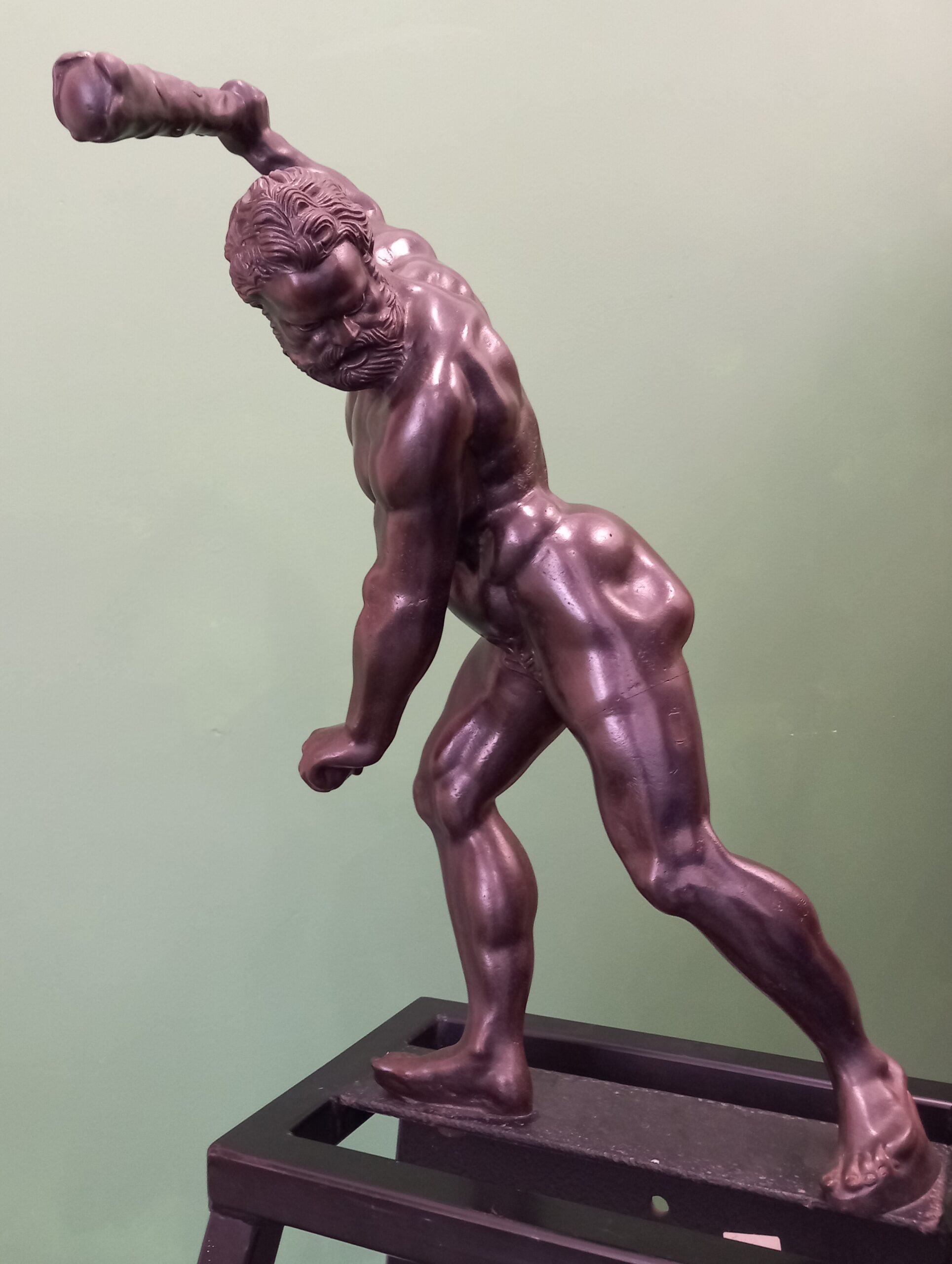
At the Westbury Heritage Centre, the committee had been debating for many years how the statuette of Hercules could be repaired after being knocked over and its club breaking off. It was decided that it was worth applying to the show.
After a flurry of emails with the production company, Hercules was accepted as a candidate. He was carefully removed from his plinth, loaded into the boot of a car and driven to the filming location in West Sussex. Once there it was explained that he had stood by the beam engine in the Bitham Mill and had been saved from being sent for scrap when the mill had converted to electricity. The damage was examined and he was left for the team to work their magic.
A few days later we received word that the repair had been done, and we were asked to return to collect him. We decided to see if we could have Hercules delivered back home and the “reveal” filmed in the heritage centre. After all, without being bolted to his plinth, he couldn’t stand unaided and we wanted to appreciate him in his full glory. This was approved and a well wrapped Hercules was couriered home and went back in the car boot.
By the time of filming, we had been in contact with mill engineer Jack Ingram’s daughter and she was able to be there and explain how her father had hidden Hercules to avoid his destruction and taken him home many years later when the mill had closed in the late 1960s.
Volunteers at the centre came to watch, the wrapping was removed, several times, and we were genuinely amazed at how good the repair was. The damage was almost invisible. With due ceremony Hercules was returned to his plinth and securely bolted into place.
All this time we had no idea how the repair had been done. The second series of The Repair Shop was broadcast, but no sign of Hercules. We began to think he had failed to make the cut.
Eventually, in August 2018, we got the news we were waiting for. The third series began and Hercules appeared in episode thirteen. At last, we found out how the repair was accomplished.
Blacksmith conservator Matthew Boultwood had carefully drilled a hole at a slight angle through the part of the club that had broken off and where it should be attached. He then inserted a metal pin and hid the ends with a solution that blended in with the original finish. It is a technique called a Roman joint and it seemed appropriate that a model portraying a figure from classical times should be fixed in this way.
Apart from getting Hercules restored, we had also hoped that the publicity from the programme would answer questions about his origin. Where had he been made and were there other similar statuettes still around? Since the programme was first shown we have learnt that he is not unique. We still do not know who made him, but it does seem there were other Hercules in woollen mills, mainly in West Yorkshire. We hope to find out more.
In the meantime, why not come and visit Hercules in Westbury Museum? Opening times are on our website at westburyheritagesociety.org.uk.