I grew up in Westbury in the 1930s and my parents owned and ran a shop in Maristow Street. We sold tobacco and confectionary and had a grocery section and an ice cream parlour in the summer months. The shop is today the Chiropractic Clinic.
Looking back my childhood was ordinary and uneventful but none the less satisfactory. Because Westbury in those days was a quiet, peaceful town where nothing ever happened and what did happen was just a matter of daily living.
We had our moments though. There was the annual carnival where decorated floats paraded through the town and where side marchers carried buckets to collect pennies and sixpences from the watchers to raise money to help fund the local hospital as there was no National Health Service then.
Two or three times a year a travelling fair with steam traction engines came to town and set themselves up in a field called “The Close” (A housing development now known as Gibbs Close). Also from time to time there were air shows out at Upton Scudamore or thereabouts where daredevils stood on the wings and an autogyro with a propeller on top astounded the crowd. This was long before helicopters were invented.
As kids we could venture up into the hills and play around the White Horse and go everywhere and anywhere without fear or trepidation. There was of course the local cinema The Vista, which showed Saturday matinees for us kids.
But most of all Westbury was an important rail junction in the Great Western Railway network. There were shunting yards where cargo wagons were sorted into freight trains and an engine shed where locomotives could be cleaned. Also there was a turntable where steam engines could be turned around to face in what appropriate direction they needed to travel. As kids we liked to go down a footpath by the shunting yards and watch the shunting activity. Another hobby for us was to collect steam engine names and numbers down by the signal box off Trowbridge Road Bridge.
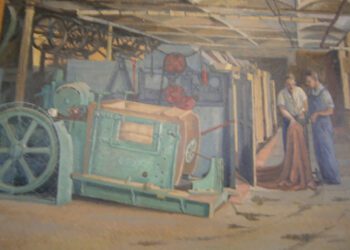
Besides the railway there was Dent’s glove factory in Church Lane and the cloth mills in Church Street where West of England cloth was weaved. On the Ham was a Craft cheese factory. Most of Westbury’s working population were employed in these and other local industries, while a few commuted by bus to Trowbridge or Warminster for work.
One feature I remember about Westbury was how everybody knew everybody either personally or by sight. If you weren’t recognised as living in Westbury you were immediately under suspicion of being a stranger in town.
There were strangers however who were known and accepted. “Walls Ice Cream” man on his “stop me and buy one” tricycle. Another accepted foreign stranger was the “Spanish onion man” who rode his bike with a string of onions around his neck. A popular busker team who carried out their act in the Market Square were the “Lofty Brothers.” One played the violin while the other danced and told jokes to the watchers. Afterwards they passed the hat around and then moved on to the next town.
Through these years I went to Mrs Arnold’s kindergarten school in Eden Vale and then to the Church junior school in Church Lane. I joined the cubs and eventually became a boy scout.
As I’ve said growing up in Westbury in those years before the war was ordinary and uneventful but, none the less, satisfactory because Westbury was a quiet peaceful town where nothing ever happened. THEN CAME THE WAR.
I remember listening to the Prime Minister Neville Chamberlain, on the radio, announcing we were at war with Germany. My father said we needed to build a bomb shelter in the garden.
He had served in World War One and was invalided out with shell shock. He knew what was in store for us all. He was one of the first to go down to the Town Hall to join the Local Defence Volunteers, later to become the Home Guard. (Dad’s Army).
Suddenly there was a flurry of action in the town. Businesses were in the street making blackout shutters and homes putting up blackout curtains. No light was to be shown at night for German bombers to see.
Everyone had to register, including us kids, and we were issued with gasmasks, ration books and identity cards. Very young children were issued with gas-masks with Micky Mouse motifs on them. We were told we had to carry the gas-masks with us at all times in case of a gas attack. At school we rehearsed going to the bomb shelter point when the air-raid siren sounded.
New categories of people came on the scene: Air Raid Wardens to ensure the blackout was strictly enforced. Also Women’s Land Army persons were billeted in the town. They were taking the place of young farm hands who were conscripted for military service.
The Ministry of War requisitioned local buildings. Leighton House became a convalescent depot for war-injured soldiers. The large house named Fontainville in Edward Street was taken over for the war effort and a regiment of British soldiers were stationed in the town.
A new phrase came into being: “There’s a war on”. The bus is late “what do you expect there’s a war on”. As a 9 year-old boy, the real horrors that all of this dealt with didn’t register with me. It was exciting and added a new dimension to my life.
The first real connection to the war for Westbury was the evacuation of the British Expeditionary Force from Dunkirk.
Local Women’s Voluntary Service members set themselves up on the platform at Westbury railway station and dished out tea and fags to the rescued soldiers as they passed through Westbury on the trains. The soldiers’ uniforms were dishevelled and some were partly dressed in civilian clothes.
The evacuation from Dunkirk not only rescued British soldiers but also French, Australian, Canadian and other Commonwealth soldiers as well, and many of them convalesced at Leighton House.
Ordinary people didn’t go abroad in those days and so when this array of soldiers from other countries came into town, Westbury suddenly became a cosmopolitan centre.
My sister and her friend could speak High School French and so my parents put a notice in their shop window: “French is spoken here”. On one occasion a French soldier asked to see the garden (or so they thought) but on showing him the garden he promptly started to relieve himself against the garden wall.
The next connection to the war for Westbury was the Battle of Britain. I remember standing in the trench which was as far as we had got in building our bomb shelter and watching a dog-fight in the sky above. The fact that there were men flying those planes trying to kill each other was lost on me. It was an exciting event to relate to other kids in the playground at school.
Later that year my whole family stood in the garden at night and watched the distant flashes in the sky and heard the rumble of bombs when Bristol was bombed. Bristol was bombed several months in a row. My father was born in Bristol and when we took a trip to see the bomb damage, large areas of the city were just heaps of rubble. We learned of the horrific number of people killed.
One Saturday afternoon at the kids’ matinee at the Vista cinema there was a terrific thud and the cinema shook. When we came out we discovered that a German plane had jettisoned its bombs. Fortunately there were no casualties but a bomb had exploded in the garden of a house in Leigh Road, twisting it on its foundations and blowing off the rear of the house and exposing the damaged furniture inside.
One very impressive memory for me was when the British regiment stationed in Westbury left the town.
They paraded in the Market Square in full dress and with their military band. They went through some drill routines and then marched off to the drum beat of the band.
A more frightening occasion was when Bath was bombed. My sister was at a dance in the Laverton Institute. My parents and I were at home and the siren had gone and we could hear the noise of aircraft flying overhead. My father and I looked out of the bedroom window expecting to see some distant flashes in the sky as when we’d seen Bristol bombed. But the entire sky was lit up by parachute flares dropped by the German path finders. As we watched there was other aircraft noise as British night fighters dived onto the German raiders. We could hear the sound of machine gun fire then an almighty thud and crash of a bomb that shook our house and caused our wardrobe doors to fly open. My father and I ducked down behind the window sill. (A bit late had the window blown in) My sister came home with her boyfriend and said they had run all the way home taking shelter now and then in shop doorways. We were all scared.
The night horizon was lit up with flashes and we could hear the heavy thud of bombs. We didn’t know where the raid was taking place. Only later did we learn it was the city of Bath. We later learned the nearby bomb had been jettisoned on waste ground in Eden Vale.
To be continued in a future issue of White Horse News