By Local Democracy Reporter Peter Davison
Visitors to Westbury White Horse were seen smoking cigarettes and leaving glass bottles beside tinder-dry grass less than 48 hours after a major wildfire near the scene of the blaze.
My trip to the Westbury White Horse came less than 24 hours after the government had sent a rare Emergency Alert to all mobile phone users, asking them not to “undertake any activity that could start a fire.”

The alert warned, “Even a small flame can rapidly develop into a major wildfire.”
At the height of the blaze, six fire crews battled to bring the fire under control.
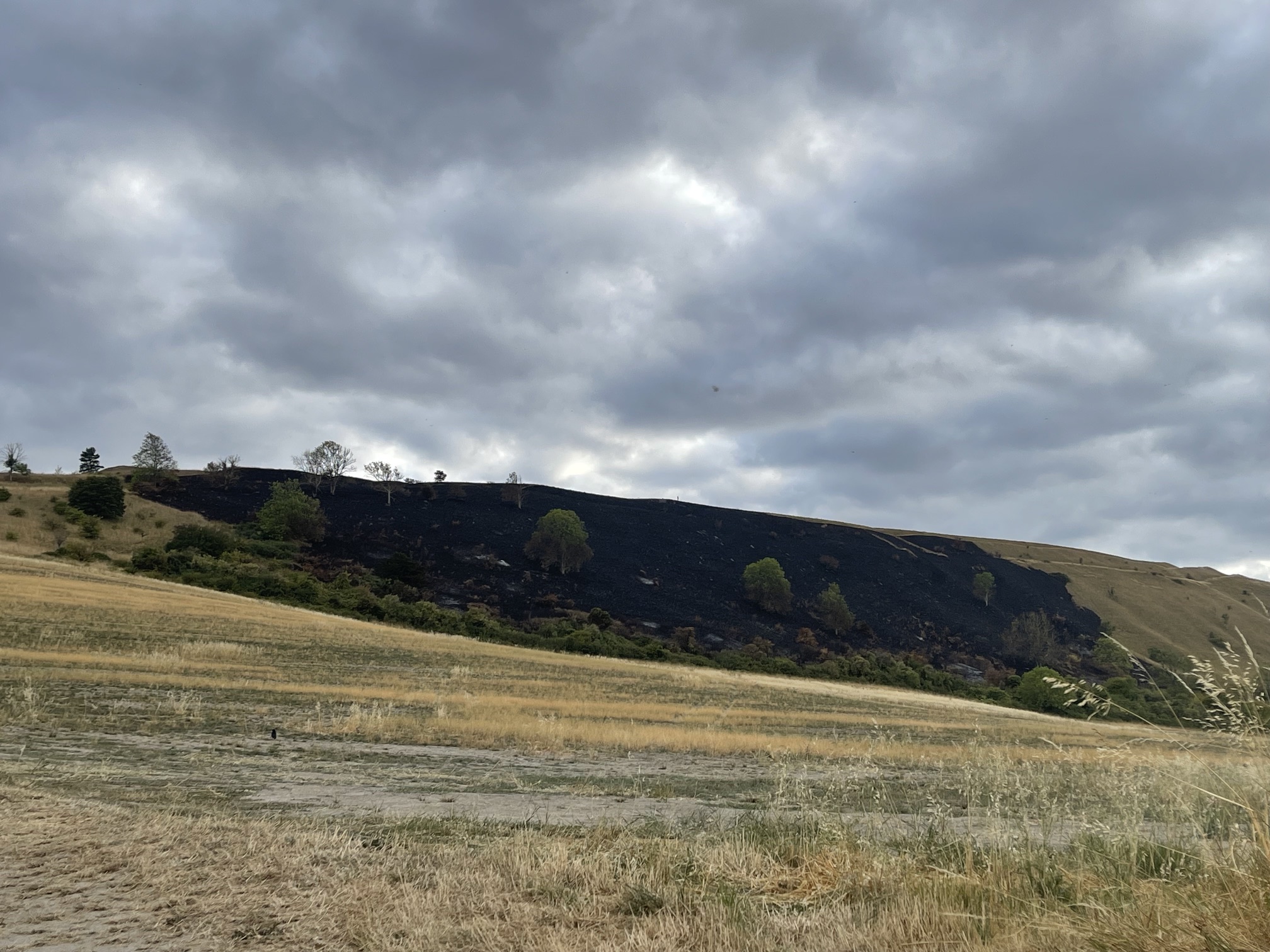
During my walk, I saw first-hand the devastation caused to the home of one of Wiltshire’s eight white horses – and the site of a 2,000-year-old hillfort.
While the steep west-facing slope into which the white horse was carved in 1778 was unscathed, the north-east plateau was charred black following the devastating wildfire which started on Thursday 13th August.
Remarkably, some trees and shrubs were still standing, but the parched grass was gone, leaving black soot and the smell of burnt vegetation.
While the cause of the blaze has yet to be established, I saw glass bottles – which can pose an ignition risk – discarded on the verge of the road to Bratton village.
Meanwhile, smokers puffed on cigarettes whilst enjoying the flame-red sunset. It was difficult to see where butts could be safely disposed of.
On my walk around the vast area destroyed by the wildfire, a local told me how he had watched from the bottom of the hill as flames took hold.
“There was a wall of fire a mile long,” he said.
Another said she was glad the westerly slope had escaped the fire. “Everybody loves the white horse. It’s part of our heritage,” she told me.
Incredibly, the fire had managed what Guthrum’s Viking invaders had failed to do in 878 AD – breach the ramparts at the top of the hill.
Back at the white horse, paragliders descended from the hilltop, children flew kites, and the ice cream van was doing brisk trade.
A group of teenagers slid down the forehead of the white horse to socialise on his muzzle.
There was no sign – I was relieved to find – of visitors lighting barbecues.
Nearby, an installation of 29 steel silhouettes – erected last year – informed visitors that the hilltop was part of an active Army training area.
And a beacon, erected for the Golden Jubilee of Queen Elizabeth II in 2002, served as a reminder that under normal weather conditions it was possible to light fires without risking the landscape.
Send us your news!
Help us keep your community connected and informed.
Do you have an interesting story you would like to share? Have you seen something you feel needs more attention? Get in touch with a reporter today!
✉️ Click here to get in touch with a reporterSupport White Horse News
Help us keep your community connected and informed.
Local news is under pressure more than ever. Choose a monthly subscription or a one-off donation to support independent reporting in White Horse News.