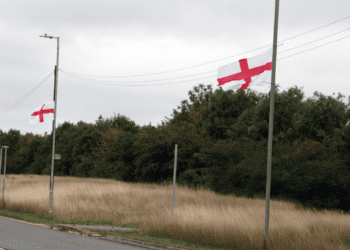
THE wildflower meadow at the White Horse has been described as a ‘desert’ by Westbury Mayor cllr Sheila Kimmins following grass cutting work by Wiltshire Council that she says has disrupted the wildlife and growth of wildflowers in the area.
Wiltshire Council completed a wildflower mowing of the area in April as a way to promote and encourage wildflower growth, but cllr Kimmins has criticised the timing of the mow as she says it has disrupted the ground nesting birds, pollinators, and early blooming wildflowers in the area.
Cllr Kimmins also says that the work to cut the grass has actually made it difficult for walkers to see the previously-mowed paths throughout the meadow and that as a result, people are trampling through the area designated for wildflowers.
She explained, “The early walkers on the Westbury White Horse were recently welcomed with a large tractor pulling a grass cutter and mowing the whole of the area. When stopped and asked, the driver said that the cut was to encourage and protect the wildflower meadows.
“The grounds maintenance company, Idverde, had been instructed by Wilshire Council to cut the whole area in March, followed by a second overall cut in October, when the grass cuttings would be picked up. This cut was then completed in April due to the ground being too wet, which is too late in the season, and it would appear that no-one had taken into consideration the ground nesting birds, nor the early blooming wildflowers.
“As a result, the Westbury White Horse has been massacred and is now a desert; the footpaths are gone, so everyone is wandering across the whole area, there are no longer any skylarks or other birds, there are no longer any primroses, cowslips, violets not even a hardy dandelion can be seen.
“There was a wide and varied selection of bees which pollinated the early wildflowers – there is not now a bee to be seen. But worst of all, the protected wild orchids have not only been cut down, but squashed into the ground under the tractor’s wheels, never to reappear. Well done, Wiltshire Council. Your policy for protecting the flora and fauna of the county and working to a carbon-free environment is really working well.”
Wiltshire Council has apologised for the area not being mowed earlier in the year and added that visual checks were carried out to ensure that nesting birds were left alone.
Cabinet member for street scene at Wiltshire Council, Caroline Thomas said, “This area has been identified as an area for conservation and a wildflower mowing should have been completed in March. We apologise that this didn’t happen because of the very wet weather and that the cut was pushed back into April which is far from ideal and possibly should have been left until October.
“All grass cutting is undertaken in line with guidance and legislation, and during the bird nesting season visual checks are carried at the time of cutting and any bird nesting areas left alone.”
Cllr Kimmins has also criticised the way that the waste from the wildflower mow was dealt with following stacks of grass cuttings being dumped at the edge of the site, some up to three foot tall and 20 feet long, as she says this is smothering the plants underneath it and that it will take a long time to decompose due to the lack of air flow.
She added, “We are now mid-April, yet there is now a large tractor driving across the whole of the area picking up the grass cuttings and dumping them in large heaps. The first heap, under the fir tree copes is smothering the wildflowers growing there. The remaining heaps are along the boundary fence to the farm, smothering the daffodils which will never be able to come up through six feet of grass cuttings.”
Cllr Thomas said in response, “For wildflower areas it is best to remove cuttings to promote the right soil nutrient balance. To reduce the carbon impact, onsite composting is the best solution, and this also offers an improved habitat for wildlife such as slow worms. We recognise that communities have differing views on grass cutting and we are happy to consider leaving this area uncut in future if this is what the community and town council want.
“Our street scene team is always happy to work with communities to agree the best grass cutting schedule for their area and town or parish councils are encouraged to contact us if there are areas they wish to be left uncut and we will be pleased to consider the request.”
In response to the council’s comments, cllr Kimmins has hit back at their approach to maintain the area and added that the dumped grass cuttings were unlikely to decompose naturally due to the lack of air flow in the piles.
She said, “With global warming, spring is coming earlier so when cutting is being planned, then February or earlier should be in the plan. Although March was a wet month, this did not stop the wildflowers from growing nor the birds from nesting, so if the contractors could not find a few dry days, then the area should have been left till October.
“As for the dumped grass cuttings naturally decomposing – any gardener will tell you that if you pile grass on top of grass it will not compost as the air cannot circulate throughout the mound so what we shall have all along the boundary of the White Horse is piles of smelling silage, and no daffodils, cowslips etc next year.
“I hope that some of the fauna and flora may return, but it will take more than a year and flowers such as the wild orchids will never return.”